VPSServer NAT VPS Review (2026): Port Forwarding, $7/yr Pricing, Free Trial, and SLA
Published 2026-11-01Category: VPS Providers
VPSServer NAT VPS provides budget Linux hosting with shared IPv4 and port forwarding from $7/year. Review of global locations, trial terms, refunds, and SLA.

Linux users comfortable with port forwarding looking for a $7/yr SSD NAT VPS
Users needing dedicated IPv4, Windows, or the standard 30-day free trial
Table of contents
- 1.VPSServer NAT VPS Coupon Codes (Verified November 8, 2026)
- 2.VPSServer NAT VPS: The Short Answer
- 3.What Company Operates VPSServer?
- 4.What Is VPSServer NAT VPS?
- 5.VPSServer Data Centers and Network Routes
- 5.1.North American and European Locations for Standard Cloud VPS
- 5.2.Asia-Pacific, Middle East, and Australian Locations for Standard Cloud VPS
- 5.3.Redundancy and Reliability Disclosures
- 6.Choosing a VPSServer NAT VPS Plan
- 6.1.Practical Selection Logic for NAT VPS
- 6.2.Billing, Recurring Charges, and Cancellation
- 6.3.Service Level Agreements, Data Policy, and Prohibited Use
- 6.4.Pre-Deployment Checklist for NAT Instances
- 7.VPSServer NAT VPS Pros and Cons
- 8.FAQ
- 9.Sources
VPSServer NAT VPS Coupon Codes (Verified November 8, 2026)
There are currently no active public coupon codes for VPSServer NAT VPS. The provider publishes no promo code input fields on either its NAT VPS landing page or free trial registration pages. The primary promotion advertised by VPSServer is a 30-day free trial with up to $100 credit for standard cloud VPS instances; the NAT VPS product comparison table explicitly states “No free trial or credits”, so standard cloud trial promotions do not apply to NAT plans.
The standard cloud trial permits 1 server valued up to $100, 1 TB block storage, and 1 TB outbound bandwidth. If all active servers and add-on services are not terminated within the account before the trial period concludes, standard billing commences automatically. New customers who do not pass 3D Secure credit card authorization can onboard as prepaid clients by depositing a fully refundable $10 security deposit, which is refunded upon cancellation within the 30-day trial window. We will update this section if dedicated coupon codes are introduced.
VPSServer NAT VPS: The Short Answer
VPSServer NAT VPS suits self-reliant Linux users comfortable with shared NAT IPv4 addressing and port forwarding who want ultra-low-cost hosting for personal sites, reverse proxies, or lightweight VPNs. The official product page advertises NAT VPS starting at $7/yr, utilizing SSD storage, offering full root credentials, focusing on Linux distributions, and reducing infrastructure costs by pooling multiple virtual machines behind a single public IP address.
Three groups of users should avoid choosing NAT VPS directly:
- Those who require dedicated public IPv4 addressing with arbitrary open ports: The fundamental architecture relies on shared NAT IPv4 pools, requiring port forwarding for inbound connections;
- Those needing Windows Server environments, managed support, or live human assistance: Documentation notes that NAT VPS is an unmanaged product built for Linux with limited support;
- Those requiring transparent data center choice, full plan specification tables, or a dedicated NAT SLA: Public NAT pages do not publish a comprehensive data center location selector, detailed hardware tables, or a NAT-specific service level agreement.
To review NAT specifications or explore standard cloud VPS trials, visit the VPSServer official website.
We have not completed independent hardware benchmark testing on VPSServer NAT VPS. Factual statements in this review reflect verified documentation on VPSServer’s official website cited at the end of the article.
What Company Operates VPSServer?
VPSServer.com states that it has over 25 years of industry hosting experience delivering low-latency cloud infrastructure, with copyright notices indicating 1995–2026 VPSServer.com. Legal agreements specify that VPSServer operates via a network of affiliated international entities; payment processing for United States customers may be handled by group affiliate Kamatera Inc. where applicable.
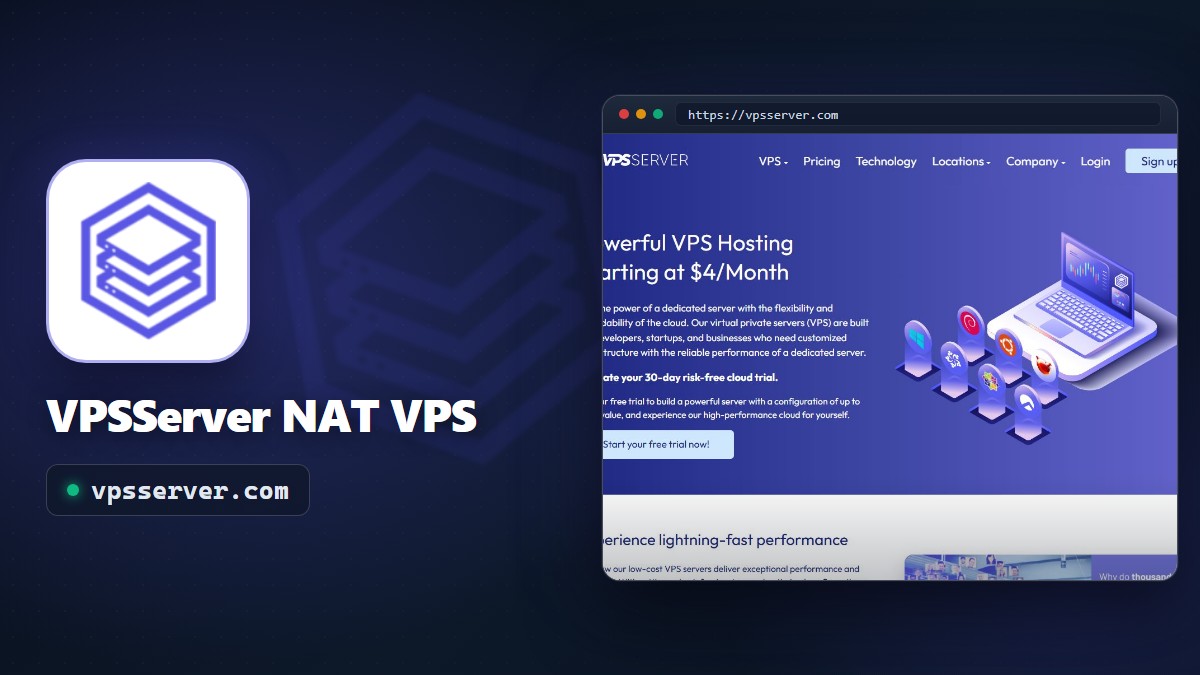
The company presents standard cloud VPS and NAT VPS side-by-side within its product architecture. Standard cloud VPS provides over 20 global locations, NVMe SSD storage, Linux and Windows operating systems, a management console, snapshots, networking, and firewall management. NAT VPS is positioned as a budget-conscious sub-product: the comparison table contrasts NAT VPS from $7/yr with SSD storage, unmanaged Linux operation, and limited support against standard cloud VPS starting at $4/mo with NVMe SSD storage, Windows and Linux support, optional managed operations, and 24/7 technical assistance.
This distinction is fundamental. Features available on standard cloud instances—such as 20+ locations, cloud console controls, NVMe storage, free trials, and 24/7 support—do not automatically carry over to the NAT tier.
What Is VPSServer NAT VPS?
NAT stands for Network Address Translation. VPSServer explains NAT VPS as a setup where multiple virtual instances share and route through a single public IP address, reducing administrative IP overhead and lowering retail prices. Users retain full root access, but instances do not receive dedicated public IPv4 addresses; exposing SSH, web servers, or custom applications requires mapping available external ports on the shared IP to the container or virtual machine.
The provider notes that NAT VPS supports port forwarding and firewall rules, providing several usable external ports. However, publicly accessible pages do not specify exact port counts, port number ranges, add-on port pricing, IPv6 availability, or dedicated IPv4 upgrade options. Verifying application port compatibility is therefore critical before ordering based on the $7/yr entry price.
The NAT VPS page indicates that instances run primarily on Linux with standard SSD storage rather than guaranteed NVMe SSDs. Workloads include personal blogs, private VPN tunnels, NAT IPv4 reverse proxy caching, and minor Linux utilities. The provider designates NAT plans as unmanaged with limited technical support, meaning server security, application setups, operating system maintenance, and port mapping remain customer responsibilities.
VPSServer Data Centers and Network Routes
The standard VPSServer cloud locations page lists over 20 global facilities spanning North America, Europe, the Middle East, the Asia-Pacific region, and Australia. By contrast, the NAT VPS page contains limited facility details and does not publish a confirmed facility list for NAT deployments. Standard cloud locations should not be assumed for NAT orders.
North American and European Locations for Standard Cloud VPS
Public North American locations for standard cloud instances include Chicago, Dallas, New York, Silicon Valley, Miami, Atlanta, Los Angeles, Seattle, and Toronto. European facilities include Amsterdam, Frankfurt, London, Milan, Madrid, Stockholm, and Bucharest. The provider includes speed test endpoints and recommends selecting locations near target audiences to minimize network latency.
Asia-Pacific, Middle East, and Australian Locations for Standard Cloud VPS
Standard cloud VPS nodes operate in Hong Kong, Singapore, Tokyo, Sydney, alongside Middle Eastern locations in Tel Aviv, Haifa, Petah Tikva, and Rosh Haain. Published documentation does not guarantee mainland China optimized routing, CN2 GIA, AS9929, CMIN2, or dedicated carrier return paths.
Redundancy and Reliability Disclosures
Locations documentation notes that standard cloud servers connect to UPS systems featuring N+1 redundancy, automated network failover, diverse upstream transit providers, redundant core switching, and enterprise routing gear. Promotional trial pages cite 99.95% uptime, while formal Service Level Agreements define baseline availability as at least 99.9%. The NAT VPS landing page lists no independent uptime commitment.
Choosing a VPSServer NAT VPS Plan
According to the official NAT VPS page verified on November 8, 2026, the published specification confirms $7/yr pricing, Linux support, SSD storage, full root access, shared NAT IPv4, port forwarding, unmanaged operation, and limited technical support. Public documentation does not disclose specific CPU core counts, RAM allocations, disk capacities, monthly transfer quotas, port speeds, port counts, or data center assignments for the entry tier.
| Product Tier | Base Published Specs | Network & Architecture | Target Use Case |
|---|---|---|---|
| NAT VPS | From $7/yr | Shared NAT IPv4, port forwarding, Linux, SSD | Lightweight sites, reverse proxies, private VPN, self-managed Linux |
| Standard Cloud VPS | From $4/mo or $0.005/hr | 1 dedicated public IPv4, Linux/Windows, NVMe SSD, 20+ locations | Production workloads requiring complete specifications and trials |
| Standard Cloud Free Trial | 30 days, up to $100 credit | 1 server instance, 1 TB block storage, 1 TB outbound bandwidth | Testing platform console, templates, and datacenter connectivity |
The standard cloud VPS configurator provides Starter (Type A), Standard (Type B), and Enterprise (Type D) tiers scaling from 1 GB to 128 GB RAM, 20 GB to 4 TB NVMe SSD storage, and multiple Linux and Windows images. Base pricing defaults to $4/mo or $0.005/hr, including 1–5 TB/mo bandwidth or 50 Mbit/s unmetered profiles with 1 dedicated IPv4 address; bandwidth overages cost $0.01/GB. These figures illustrate the product hierarchy and should not be confused with NAT tier allocations.
Practical Selection Logic for NAT VPS
If your goal involves low-frequency SSH management, personal static blogs, reverse proxy forwarding, or hosting services requiring few known ports, shared NAT IPv4 with port forwarding is adequate and the low annual rate is cost-effective. For web services, establish your reverse proxy and domain setup first, confirming whether HTTP and HTTPS ports can be forwarded. For private VPN tunnels, verify protocol requirements across UDP and TCP ports.
If your application requires binding directly to a dedicated public IPv4 address, listening on standard ports, running Windows Server, utilizing routine snapshot backups, or relying on provider support, standard cloud instances are better suited. Product pages do not list a custom control panel for NAT plans; standard cloud documentation describes a management portal for provisioning, monitoring, snapshots, and firewall rules.
Billing, Recurring Charges, and Cancellation
Terms state that payments are accepted via credit card and PayPal. Hourly instances are invoiced after the first day of each calendar month for accrued usage, while monthly plans bill at the start of each service term. Failure to maintain payment authorizes service suspension or termination without data retention obligations.
Following the conclusion of free trial or promotional intervals, accounts automatically incur standard charges unless all active server instances and add-ons are terminated. Subscriptions can be canceled at any time: terminated hourly instances cease generating charges immediately; monthly servers are prepaid and do not issue refunds for current cycles; licensed software and add-ons are non-refundable.
Terms state that published prices and fees are non-refundable unless explicitly specified, with exceptions granted entirely at provider discretion. The NAT VPS page contains no dedicated money-back guarantee. Account cancellation results in immediate data deletion, requiring users to secure backups beforehand.
Service Level Agreements, Data Policy, and Prohibited Use
Standard cloud SLA documentation defines 99.9% uptime as permitting a maximum of 8 hours of cumulative downtime within a service year. If VPSServer fails to meet this threshold, eligible customers receive 1 month of free service up to a maximum value of $5,000, limited to once within any 12-month window. Written credit claims must be submitted within 14 days of an incident, detailing outage duration, impacted accounts, and mitigation measures taken.
The SLA includes extensive exclusions covering force majeure, third-party software failures, corrupt backups, failure to implement technical recommendations, load exceeding reasonable operating parameters, scheduled maintenance with 7 days notice, emergency maintenance with 24 hours notice, DNS failures, client actions, and general claims rejected under provider discretion. The NAT VPS page does not confirm SLA applicability to NAT plans.
Acceptable Use Policies forbid spam, phishing, intellectual property violations, unauthorized port scanning, flooding, IP spoofing, brute-force cracking, and IRC abuse. If user behavior results in mail servers or IP ranges becoming blacklisted, terms mandate an immediate $100 deposit and remediation charges assessed at $200/hr. The low cost of NAT plans does not relax abuse terms.
Pre-Deployment Checklist for NAT Instances
The primary operational constraint on NAT VPS is public network ingress rather than hardware compute limits. Prior to purchasing, confirm which TCP or UDP ports your service requires, whether multiple distinct services must listen externally, whether arbitrary inbound ports are required, and whether reverse proxy routing accommodates your domain needs. The provider confirms port forwarding with several assignable ports but omits detailed forwarding limits, which should be verified at checkout.
Self-management expertise on Linux must be factored into deployment costs. Root access allows full configuration of SSH keys, local firewalls, web daemons, and system updates. However, NAT documentation specifically notes limited support, meaning users cannot rely on the 24/7 technical team advertised for standard cloud plans. For hobby projects and test servers that can tolerate interruptions, low annual pricing offers clear value; for production operations, external monitoring and offsite backups are essential.
Testing standard cloud trials provides insight into dashboard interfaces and networking, but does not validate NAT port forwarding constraints. If your architecture ultimately demands dedicated public IPv4 addressing, unconstrained ports, or Windows environments, standard cloud configurations should be evaluated directly rather than attempting to adapt a NAT instance.
VPSServer NAT VPS Pros and Cons
Pros
- Transparent starting price of $7/yr suits ultra-budget Linux workloads;
- Full root credentials permit custom software deployment, firewall configuration, and port forwarding rules;
- Shared NAT IPv4 pooling minimizes IPv4 addressing overhead for small projects;
- Clear baseline documentation specifying SSD storage, port forwarding, and Linux compatibility;
- Standard cloud tier provides over 20 global locations, Windows/Linux support, NVMe storage, and 30-day trials as a potential upgrade path.
Cons
- Shared NAT IPv4 architecture and port forwarding do not accommodate services requiring standard unmapped ports;
- Published pages omit full hardware specifications, exact port counts, bandwidth quotas, data center locations, and SLA terms;
- Unmanaged Linux environment with limited support is unsuitable for non-technical users;
- NAT plans carry no free trials or promotional credits;
- Fees are non-refundable by default, and account cancellation causes immediate data loss.
For additional hosting providers, server locations, pricing comparisons, and coupons, explore our VPS Provider Directory or browse servers by geographical region.
FAQ
Does VPSServer NAT VPS have active coupon codes?
As of November 8, 2026, there are no active public coupon codes for NAT VPS. The provider advertises a 30-day trial with up to $100 credit for standard cloud VPS; NAT comparison tables explicitly specify no free trials or promotional credits.
How much does VPSServer NAT VPS cost?
Documentation states that NAT VPS starts from $7/yr. Public pages do not publish specific CPU, RAM, disk, transfer quotas, or datacenter locations tied to this baseline rate, requiring verification during ordering.
Does NAT VPS include a dedicated public IPv4 address?
No. NAT VPS operates with shared NAT IPv4 addressing. The provider indicates that external traffic is handled through port forwarding rather than dedicated public IPv4 allocations.
Does NAT VPS support Windows Server?
No. Official documentation states that NAT VPS is designed primarily for Linux. While standard cloud VPS supports Windows and Linux, that is an independent product line.
Can I get a refund on a VPSServer NAT VPS?
There is no dedicated refund policy published for NAT VPS. General terms state that fees are non-refundable unless explicitly noted, with refunds evaluated on a case-by-case basis.
What is included in the VPSServer standard cloud free trial?
The 30-day trial applies to standard cloud VPS, providing 1 server instance valued up to $100, 1 TB block storage, and 1 TB outbound transfer. Active services must be canceled prior to trial expiration to avoid automated charges.
What payment methods does VPSServer accept?
Terms list credit cards and PayPal. Customers failing 3D Secure card verification can register as prepaid clients by submitting a refundable $10 deposit, returned upon cancellation within the 30-day trial period.
Is VPSServer NAT VPS suitable for hosting websites?
It suits lightweight personal sites where the administrator can manage Linux configuration, shared NAT IPv4 mapping, and reverse proxy routing. Projects requiring standard web ports, dedicated IPs, or managed technical support should choose standard cloud VPS.
Sources
The following pages were verified on November 8, 2026:
- VPSServer NAT VPS, Homepage, and About: vpsserver.com/nat-vps/, vpsserver.com/, vpsserver.com/about/
- Standard Cloud Pricing, Locations, and Free Trial: vpsserver.com/plans/, vpsserver.com/locations/, vpsserver.com/free-vps-server/
- Terms and Conditions, Acceptable Use Policy, and SLA: vpsserver.com/terms-and-conditions/
To review NAT specifications or test standard cloud trials, visit the VPSServer official website.
Spotted outdated pricing, stock, or expired coupons?See methodology & report an update →