Kamatera Review (2026): Global Cloud VPS, Hourly Billing, Free Trial, and SLA
Published 2026-11-01Category: VPS Providers
Kamatera provides customizable cloud servers across 25 global data centers with hourly billing. Review covers pricing from $4/mo, $100 free trial, and SLA terms.

Teams wanting a 30-day $100 trial and granular CPU/RAM cloud scaling
Fixed annual budget hunters or users expecting fully managed OS care
Table of contents
- 1.Kamatera Promo Codes (Verified November 8, 2026)
- 2.Kamatera Review: The Short Answer
- 3.Who Operates Kamatera
- 4.Kamatera Locations and Network
- 4.1.Asia, Australia, and the Middle East
- 4.2.North America and Europe
- 5.Choosing a Kamatera Plan
- 5.1.Using the Free Trial
- 5.2.Payment, Renewals, and Cancellation
- 5.3.Acceptable Use and Data Responsibility
- 5.4.Understanding Configurator Cost Elements
- 5.5.Target Workloads and Scenarios
- 6.Pros and Cons
- 7.FAQ
- 8.Sources
Kamatera Promo Codes (Verified November 8, 2026)
Kamatera does not currently offer public coupon codes. The provider’s site does not feature checkout discount codes. Instead, both the homepage and billing FAQ highlight a 30-day free trial: users can deploy a single server instance with resource configurations valued up to $100, including 1 TB of bandwidth.
The billing FAQ notes that if automated fraud detection flags repeated card submissions or irregular billing patterns, the system may require a refundable $10 deposit. Upon payment, the service activates immediately, and the deposit can be refunded or credited toward future invoices. Any instances left running after the 30-day trial will transition to standard billing. If coupon codes become available later, we will verify and publish them here.
Kamatera Review: The Short Answer
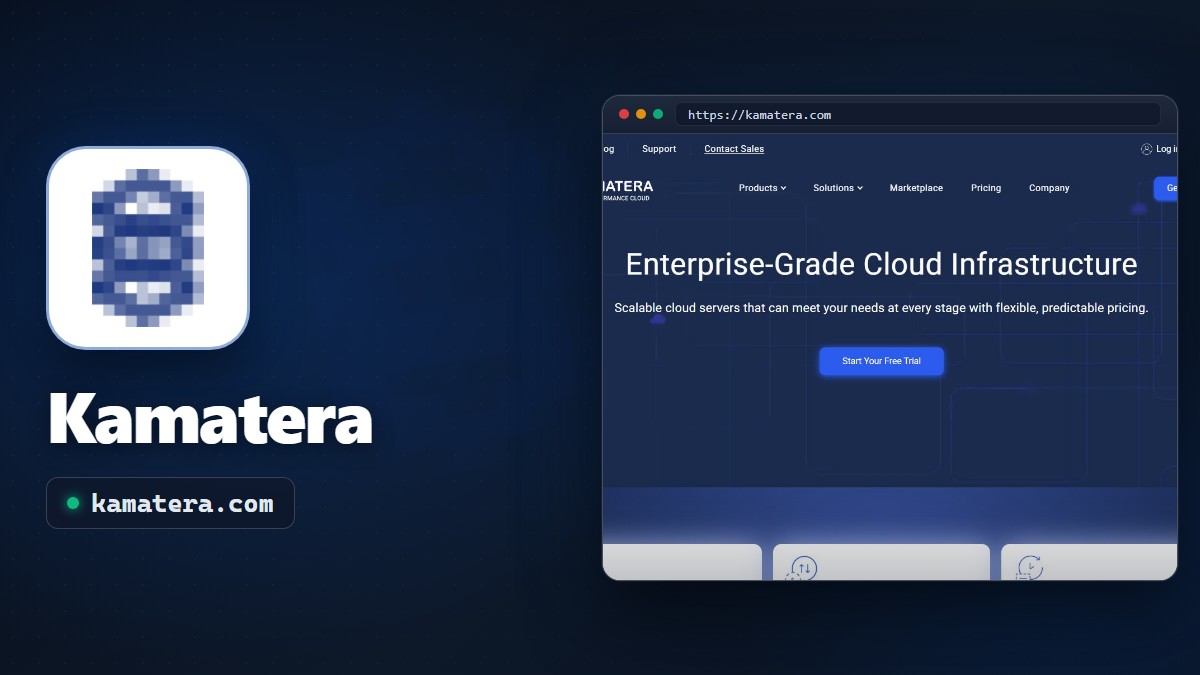
Kamatera suits developers and technical teams seeking customizable cloud servers with flexible choices in CPU type, data centers, and hourly or monthly billing. Its pricing page features instances starting at $4/mo or hourly rates. The configurator allows selection across Type A, B, D, and T server architectures, operating systems including Linux, FreeBSD, and several Windows editions, as well as up to 4 TB of NVMe SSD storage.
Three user profiles should reconsider choosing Kamatera:
- Users looking for fixed-rate cheap annual budget VPS plans: The platform focuses on utility-based monthly and hourly billing, where total charges scale dynamically based on CPU, RAM, storage, location, and software licensing.
- Users unable or unwilling to administer systems, software patches, and backups: Terms of service assign full responsibility for operating system maintenance, security patches, access control, and data backups to the client.
- Users expecting no-questions-asked cash refunds: Policies stipulate that fees are non-refundable unless explicitly stated otherwise, and billing begins automatically once the free trial period concludes.
To configure an instance directly, visit the Kamatera official website.
This site has not yet purchased and benchmarked Kamatera instances. All specifications below reflect data published on Kamatera’s official website and policies referenced at the end; recommendations and pros and cons represent our synthesis of those public disclosures.
Who Operates Kamatera
Kamatera’s website states that its parent corporation is The OMC Group, which has provided cloud and infrastructure solutions since 1995. The company history page notes that Yohay Azulay co-founded OMC in 1995 and launched Kamatera as its initial hosting brand in 1996. The site footer cites Kamatera, Inc.
The provider positions itself as an enterprise-grade cloud platform serving startups, software developers, international corporations, and small-to-medium businesses. Offerings include Cloud Servers, Cloud Desktops, Virtual Private Clouds (VPC), Cloud Firewalls, Load Balancers, block storage, and fully managed cloud services. Rather than selling static, pre-packaged VPS bundles, Kamatera enables clients to assemble specifications through an interactive resource configurator.
Regarding physical infrastructure, Kamatera states that virtual server connections to network and router backbones reach up to 10 Gbit/s, with storage arrays powered by NVMe SSD hardware or NVMe caching accelerators. Facilities feature UPS systems, N+1 redundancy, and dedicated backup generators. These figures reflect datacenter architectural standards rather than guaranteed continuous throughput for individual virtual instances.
Kamatera Locations and Network
Kamatera lists 25 data center locations spanning North America, Europe, Asia, Australia, and the Middle East. Public documentation does not advertise dedicated mainland China route optimizations such as CN2 GIA, AS9929, or CMIN2, meaning instances should not be selected expecting specialized low-latency routes to mainland China.
Asia, Australia, and the Middle East
Visible locations include Hong Kong, Tokyo, Singapore, Sydney, and Tel Aviv. The platform recommends locating servers in proximity to core users, staff, or data pipelines, displaying the three nearest data centers based on visitor geography. For Asia-Pacific audiences, Hong Kong, Tokyo, and Singapore serve as standard regional hubs, though Kamatera does not guarantee specific latency or return paths to mainland China.
North America and Europe
North American locations include Atlanta, Chicago, Dallas, Miami, New York, Los Angeles, Santa Clara, Seattle, and Toronto. European sites cover Amsterdam, Bucharest, Frankfurt, London, Madrid, Milan, and Stockholm. Datacenter documentation indicates that select facilities adhere to SOC 2 Type II compliance standards, with server hardware scheduled for refresh after three years of operation.
Selecting a location requires evaluating target audience geography followed by network testing inside the management console.
Choosing a Kamatera Plan
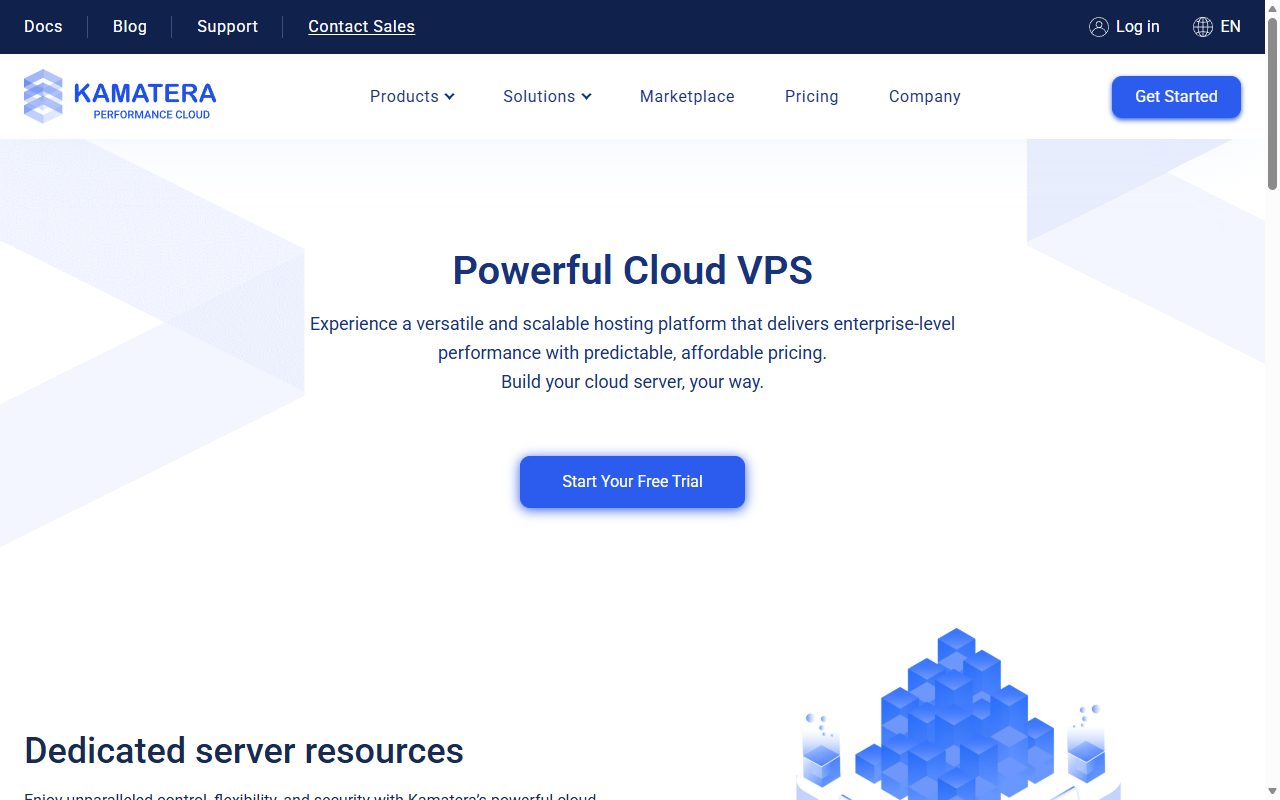
Kamatera centers on tailored cloud instances. The default example displayed on the pricing page is a Type B General Purpose server with 1 Availability Core, 512 MB RAM, 5 GB storage, 5 TB bandwidth, and Ubuntu Server, listed at $10/mo or $0.014/hour. Meanwhile, the page header highlights cloud servers starting from $4/mo. These refer to distinct baseline options rather than identical configurations.
| Plan or Type | Positioning | Published Starting Baseline |
|---|---|---|
| Cloud Servers | Custom CPU, RAM, disk, and OS | Starting from $4/mo |
| Type A | Availability, continuous uptime focus | Quoted via configurator |
| Type B | General Purpose, dedicated CPU threads | Default example at $10/mo |
| Type D | Dedicated, high performance resources | Quoted via configurator |
| Type T | Burstable, absorbs traffic spikes | Quoted via configurator |
As of November 8, 2026, Type B instances assign dedicated CPU threads, intended for standard production workloads such as web servers, application endpoints, APIs, and moderate databases. Type D Dedicated instances target resource-heavy workloads needing isolated compute. Available parameters for Type A and Type T depend on configuration selections, as complete matrices are generated dynamically.
Operating system support covers distributions including Ubuntu, Debian, AlmaLinux, Alpine, Arch, CentOS Stream, Fedora, FreeBSD, Gentoo, Linux Mint, and Rocky Linux, as well as Windows Server 2016, 2019, 2022, 2025 and Windows Desktop 10 and 11. Optional commercial software licenses such as cPanel, Plesk, or Microsoft SQL Server add extra monthly licensing costs to the bare hardware base price.
Storage scales from 20 GB to 4 TB, memory from 256 MB to 128 GB, and processor capacity up to 104 cores, subject to server tier. Additional monthly bandwidth costs $0.01/GB, while extra storage costs $0.05/GB/mo. Hourly servers are billed per minute.
Using the Free Trial
Kamatera’s 30-day free trial permits deploying a single server instance with specifications valued up to $100 and 1 TB of data transfer. It is suited for evaluating regional datacenter latency, OS templates, and configuration options. Stopped or powered-off instances continue to accrue small hourly charges for allocated IP addresses and provisioned disk storage.
Payment, Renewals, and Cancellation
The billing FAQ lists two primary payment options: major credit or debit cards displaying the cardholder’s name, and prepaid account deposits funded via card or PayPal. Specific onboarding criteria for PayPal funding appear in secondary account documentation.
The Service Level Agreement (SLA) outlines an availability target of 99.9%, allowing up to approximately 8 hours of unscheduled downtime across a full service year. If Kamatera fails to meet this threshold, compensation is provided as 1 month of complimentary service credit for affected instances, capped at a maximum value of $5,000, claimable once in any 12-month window. Clients must file a written claim within 14 days of an outage, detailing service impacts, duration, storage accounts, and mitigation measures. Planned maintenance with 7 days notice, emergency maintenance with 24 hours notice, upstream outages, and misconfigurations are excluded from SLA credits.
Acceptable Use and Data Responsibility
The Acceptable Use Policy (AUP) bans spam, phishing, intellectual property violations, unauthorized port scans, packet flooding, IP/header spoofing, brute-force attempts, and IRC abuse. If account activity results in IP addresses or mail relays getting blacklisted, terms specify an initial fee of $100 plus remediation labor billed at $200/hour. Cloud File Servers may not be repurposed for backup storage, redundant file repositories, or high-volume content distribution.
Kamatera terms stipulate that customers bear full responsibility for virtual machine security, OS patches, application code, credentials, and data backups. Users must maintain independent off-site backups rather than relying solely on infrastructure-level redundancy.
Understanding Configurator Cost Elements
Pricing on Kamatera incorporates multiple independent variables: compute resources, software licensing, storage volume, and network traffic. Beyond initial CPU, RAM, and NVMe SSD quotas, extra disk can expand between 5 GB and 4 TB. Software add-ons include cPanel Admin, Pro, and Premier; Plesk Web Admin, Pro, and Host; along with Microsoft SQL Server, Remote Desktop, and Office suites.
Budget modeling should compare base Linux hardware pricing against fully licensed stacks. While hourly billing enables short-term testing, prolonged monthly deployments should account for add-ons and data transfer costs.
Default configurations show 5 TB of monthly bandwidth, though regional notes show Asia locations allocate 1 TB monthly, with overages billed at $0.01/GB.
Target Workloads and Scenarios
The provider highlights instances for web applications, API endpoints, relational databases, CMS deployments, system monitoring, VPN tunnels, ERP platforms, virtual desktops, and financial trading setups. Lightweight web services prioritize memory and geographic proximity, while database systems require dedicated CPU threads and persistent NVMe throughput. Isolated networks can leverage optional Virtual Private Clouds and Cloud Firewalls.
Templates catalog modern releases including Ubuntu Server 26.04 LTS, Debian 13, FreeBSD 15, Rocky Linux 10, and Windows Server 2025. Verify compatibility before provisioning workloads reliant on older dependencies.
Pros and Cons
Pros
- 25 global datacenter locations covering North America, Europe, Asia, Australia, and the Middle East;
- Both monthly and hourly billing supported, with hourly instances billed per minute and flexible resource sizing;
- Extensive OS selection including Linux distributions, FreeBSD, Windows Server, and commercial add-on licenses;
- 30-day free trial covering up to $100 in resource value for initial testing;
- Published SLA with a 99.9% uptime target, structured claim rules, and defined service credits.
Cons
- No specialized direct routing or return optimizations for mainland China networks;
- Advertised $4/mo base pricing does not reflect most real-world operational hardware or Windows configurations;
- Powered-off instances continue accruing hourly storage and IP retention fees;
- Standard fees and recurring payments are non-refundable;
- Rigorous acceptable use conditions and customer-managed security requirements.
For configurations, pricing, and discount codes from other providers, visit our VPS Provider Directory or browse by server location.
FAQ
Does Kamatera offer promo codes?
As of November 8, 2026, Kamatera does not publish valid discount codes. The primary promotional offer is a 30-day free trial that allows launching a single server instance with up to $100 in resource credits and 1 TB of data transfer.
Is the Kamatera free trial completely free?
The platform offers a 30-day trial with up to $100 in credits. If automated security checks detect multiple card attempts or anomalous account details, a refundable $10 deposit may be required, which can subsequently be refunded or applied toward future usage.
What is the lowest price for a Kamatera server?
Kamatera’s pricing overview highlights cloud servers starting from $4/mo. The standard Type B reference model with 1 Availability Core, 512 MB RAM, 5 GB storage, and 5 TB transfer is priced at $10/mo or $0.014/hour, with final costs varying by selected resources and software licenses.
Which payment methods are accepted?
Official FAQs state that Kamatera accepts major credit and debit cards, as well as prepaid deposits funded via payment cards or PayPal. Additional alternative payment methods are not listed on public billing pages.
Does Kamatera have data centers in Hong Kong and Japan?
Yes. Datacenter listings include Hong Kong and Tokyo, along with Singapore. Kamatera does not advertise specialized direct mainland China network routes for these locations.
Can I request a refund from Kamatera?
Terms of service declare that fees are non-refundable unless specified otherwise. Users must actively terminate unused instances inside the control panel prior to trial expiration, as SLA compensation provides future service credits rather than cash refunds.
How does the Kamatera SLA credit policy work?
The SLA targets 99.9% availability. Verified outages qualify for 1 month of service credit for affected instances, up to a maximum value of $5,000 once per 12-month period, provided a claim is submitted within 14 days of the incident.
Sources
The following pages were referenced on November 8, 2026 from the Kamatera official website:
- Kamatera homepage and company profile: kamatera.com, kamatera.com/about-us/
- Cloud VPS, pricing overview, and datacenter locations: kamatera.com/cloud-vps/, kamatera.com/pricing/, kamatera.com/data-centers/
- Billing FAQ, payment gateways, and trial deposit policies: kamatera.com/faq/billing/, kamatera.com/faq/answer/which-payment-methods-do-you-accept/, kamatera.com/faq/answer/why-am-i-being-asked-to-make-a-deposit-during-my-30-day-free-trial-period/
- Terms of service, Acceptable Use Policy, and Service Level Agreement: kamatera.com/tos/, kamatera.com/acceptable-usage-policy/, kamatera.com/service-level-agreement/
To configure a server, visit the Kamatera official website.
Spotted outdated pricing, stock, or expired coupons?See methodology & report an update →